
Text Comparison Methodology
An overview of the three main stages of the attempt to build a ‘comparative reading tool’ of chapters I-VI, Book XIX of De l’esprit des lois to test a combination of traditional scholarly methods with modern AI technologies.
Historical Transcriptions
Converting historical printed editions into clean, analysis-ready text files using OCR technology and manual curation for scholarly accuracy.
LLM Translation & Semantic Analysis
Using Claude 3.5 Sonnet: prompted for contextual translation and semantic analysis, attuned to philosophical nuances while enabling cross-linguistic comparison.
Interactive Comparative Reading Tool
Digital interface enabling side-by-side analysis of multiple editions with synchronised navigation, highlighting, and semantic comparison capabilities.
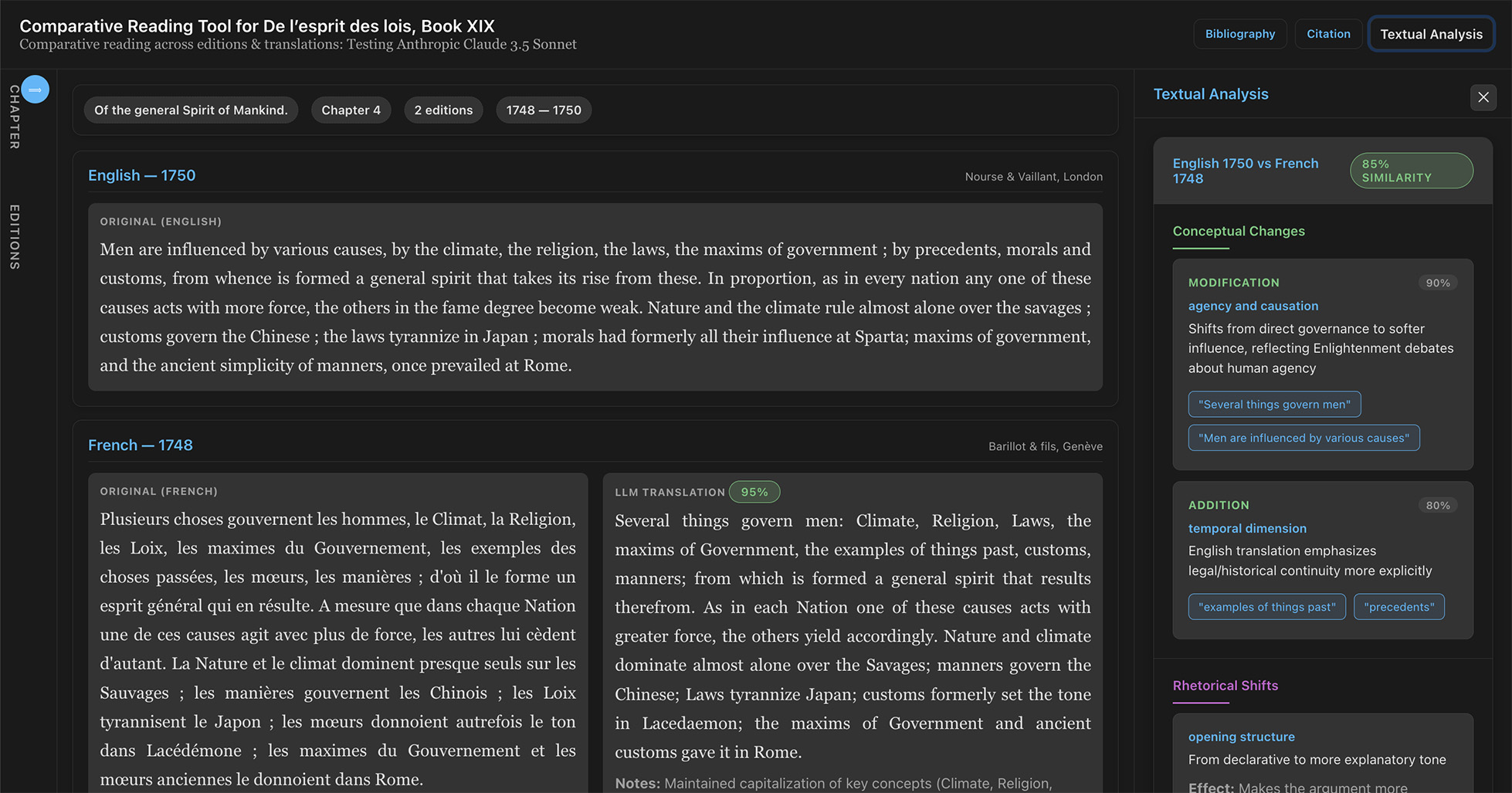
Integrated Digital Workflow
This three-stage methodology transforms historical printed texts into interactive digital resources, enabling new forms of analysis that can be evaluated against rigorous academic standards. Each stage builds upon the previous, creating a comprehensive framework for computational philology and comparative textual analysis in the digital humanities.